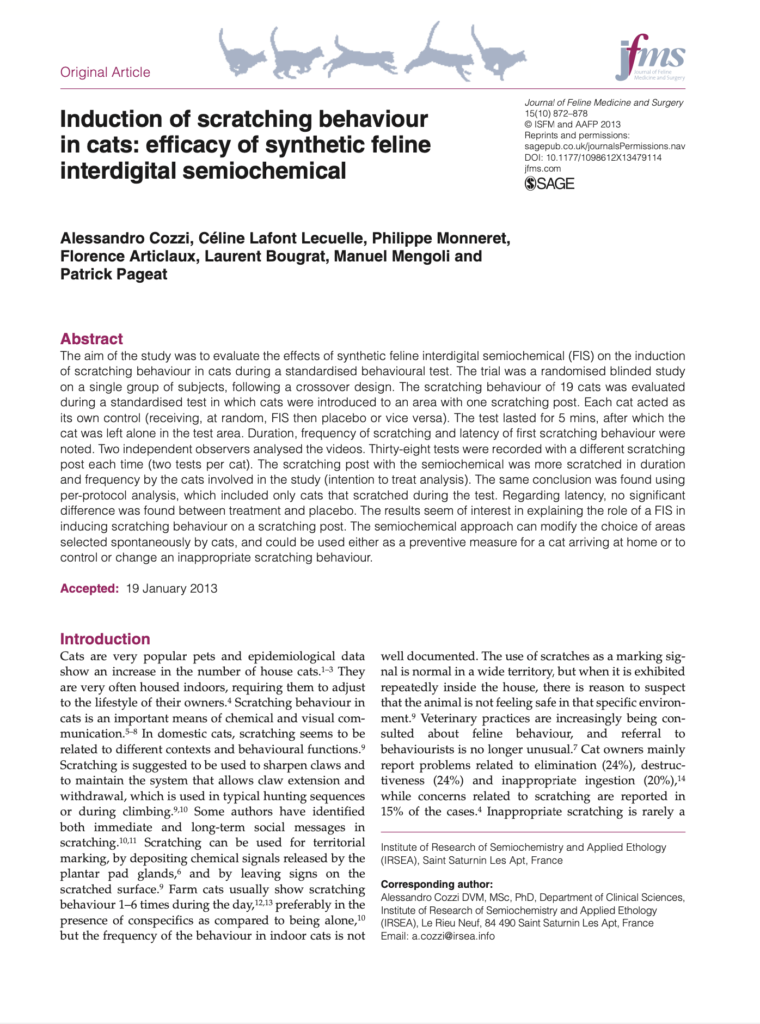
Induction of scratching behaviour in cats: efficacy of synthetic feline interdigital semiochemical 2013

Induction of scratching behaviour in cats: efficacy of synthetic feline interdigital semiochemical

Share This Post

Abstract:

The aim of the study was to evaluate the effects of synthetic feline interdigital semiochemical (FIS) on the induction of scratching behaviour in cats during a standardised behavioural test. The trial was a randomised blinded study on a single group of subjects, following a crossover design. The scratching behaviour of 19 cats was evaluated during a standardised test in which cats were introduced to an area with one scratching post. Each cat acted as its own control (receiving, at random, FIS then placebo or vice versa). The test lasted for 5 mins, after which the cat was left alone in the test area. Duration, frequency of scratching and latency of first scratching behaviour were noted. Two independent observers analysed the videos. Thirty-eight tests were recorded with a different scratching post each time (two tests per cat). The scratching post with the semiochemical was more scratched in duration and frequency by the cats involved in the study (intention to treat analysis). The same conclusion was found using per-protocol analysis, which included only cats that scratched during the test. Regarding latency, no significant difference was found between treatment and placebo. The results seem of interest in explaining the role of a FIS in inducing scratching behaviour on a scratching post. The semiochemical approach can modify the choice of areas selected spontaneously by cats, and could be used either as a preventive measure for a cat arriving at home or to control or change an inappropriate scratching behaviour. 

Auteur: Alessandro Cozzi, Céline Lafont Lecuelle, Philippe Monneret, Florence Articlaux, Laurent Bougrat, Manuel Mengoli and Patrick Pageat 

En savoir plus: https://pubmed.ncbi.nlm.nih.gov/23428583/
Jetez un œil à nos autres articles

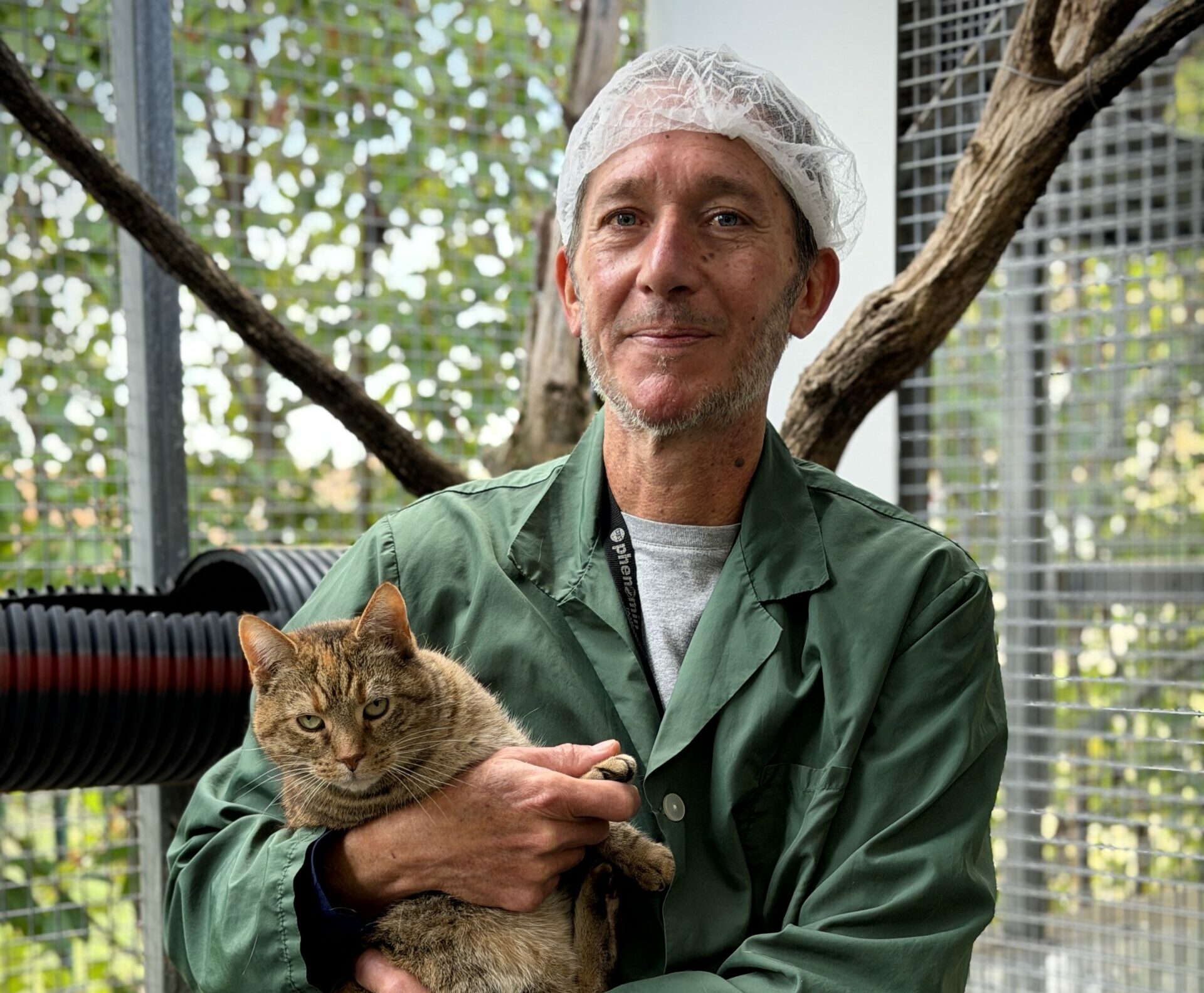
Philippe - Technicien de recherche IRSEA
INSIDE IRSEA

Philippe Monneret : technicien de recherche​

Depuis plus de vingt ans, Philippe fait partie de ces collaborateurs discrets mais essentiels qui veillent chaque jour sur les animaux de l’IRSEA. Technicien de recherche passionné, il se distingue par son attention quotidienne, sa connaissance fine de nos animaux et de leurs comportements. Cette expertise précieuse lui permet de contribuer activement à la préparation et au déroulement des essais scientifiques, en étroite collaboration avec les équipes de recherche.

30 Irsea - naissance de l'Institut
HISTOIRE IRSEA

30 ans de recherche et d’innovation

Depuis 1995, l’IRSEA explore les langages invisibles du vivant. Fondé à Apt par le Dr Patrick Pageat, l’Institut est devenu un centre de recherche pionnier en sémiochimie et éthologie appliquée, avec plus de 40 collaborateur·rices et 400 brevets. Un institut de référence sur la communication chimique entre les espèces, pionnier et engagé pour une science éthique, innovante et utile, au service du vivant.

INSIDE IRSEA

Alessandro Cozzi : Directeur général

Directeur général et directeur recherche et enseignement de l’IRSEA, il supervise les équipes et les projets, entre science et gestion. Passionné par la recherche fondamentale et appliquée, il aime voir naître et évoluer les idées. Son rôle consiste aussi à accompagner les personnes et à bâtir un cadre pour faire grandir l’Institut. Inscrivant l’IRSEA dans une démarche One Health, il s’appuie sur une expertise pluridisciplinaire et le biomimétisme pour développer des solutions utiles au bien-être animal, à la santé animale et humaine.

INSIDE IRSEA

Ennia Bracco : Technicienne de recherche

Technicienne de recherche à l’IRSEA, elle réalise des analyses de matrices animales, végétales ou insectes pour identifier des molécules messagères chimiques. Elle collabore avec les chercheur·euses et ingénieur·es pour apporter des réponses concrètes aux projets scientifiques, retraitant et interprétant les données, rédigeant des rapports et assurant la gestion des déchets chimiques. Passionnée par l’exploration de l’inconnu, elle aime investiguer et se remettre en question chaque jour pour faire avancer la recherche.